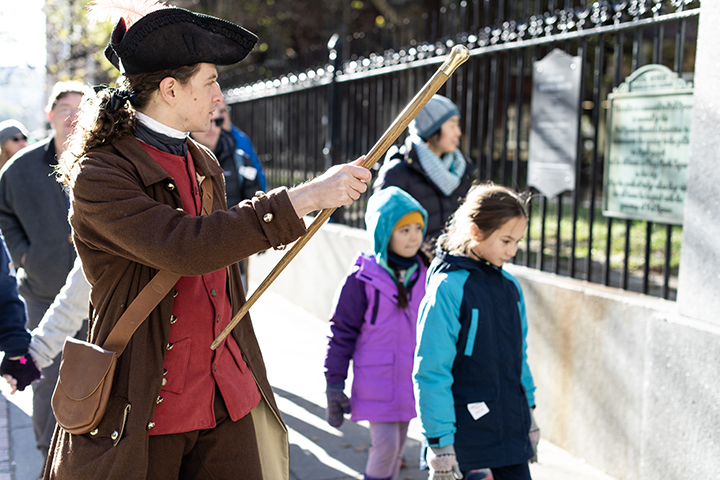
Boston’s Freedom Trail, a 2.5-mile red-brick path winding through the heart of the city, offers an immersive journey into the origins of the American Revolution. Connecting 16 historically significant sites, this iconic trail draws history buffs, curious travelers, and locals alike to explore the stories of the nation’s founding. In 2025, as Massachusetts celebrates the 250th anniversary of key revolutionary events, the Freedom Trail remains a must-visit attraction, recognized as one of the world’s top walking trails by AllTrails.
The Origins of the Freedom Trail
Conceived in 1951 by William Schofield, a Boston Herald journalist, and Bob Winn of the Old North Church, the Freedom Trail was created to guide visitors through Boston’s historic landmarks without getting lost. Officially established on June 11, 1951, the trail’s red-brick or painted line ensures easy navigation through bustling streets, from Boston Common to the Bunker Hill Monument in Charlestown.
Key Stops Along the Trail
The Freedom Trail begins at Boston Common, America’s oldest public park, established in 1634. Once a site for cattle grazing and public hangings, it now serves as a vibrant community space. Visitors can start their journey at the Boston Common Visitor Center (139 Tremont Street), where maps and information are available.
From there, the trail leads to the Massachusetts State House, a Federal-style masterpiece designed by Charles Bulfinch and completed in 1798. Its iconic gold dome, originally covered in copper by Paul Revere, gleams atop Beacon Hill. Free guided tours are offered weekdays, providing insights into its role as the state’s political hub.
The Park Street Church, built in 1809, marks another stop, known for its role in the abolitionist movement and as the site where “My Country ’Tis of Thee” was first sung in 1831. Nearby, the Granary Burying Ground houses the graves of revolutionary giants like Paul Revere, Samuel Adams, and John Hancock, offering a poignant glimpse into Boston’s past.
Further along, the King’s Chapel and Burying Ground, established in 1686, showcases Georgian architecture and Boston’s oldest graveyard, where early colonial figures rest. The Boston Latin School Site, marked by a Benjamin Franklin statue, honors America’s first public school, founded in 1635.
The Old Corner Bookstore, a 1712 structure, once hosted literary luminaries like Hawthorne and Dickens, while the Old South Meeting House is famed as the launch point for the Boston Tea Party in 1773. The Old State House, built in 1713, features a balcony where the Declaration of Independence was first read in 1776, and the nearby Boston Massacre Site commemorates the 1770 clash that fueled revolutionary fervor.
The trail continues to Faneuil Hall, dubbed the “Cradle of Liberty” for its role in revolutionary debates, and the Paul Revere House, Boston’s oldest residential building, dating to 1680. The Old North Church, immortalized by Paul Revere’s “one if by land, two if by sea” signal, and Copp’s Hill Burying Ground offer further historical depth in the North End.
The trail concludes in Charlestown with the USS Constitution, the world’s oldest commissioned warship still afloat, and the Bunker Hill Monument, marking the Revolution’s first major battle in 1775. The monument, illuminated nightly through July 4, 2025, stands as a symbol of sacrifice and resilience.
Experiencing the Freedom Trail in 2025
Walking the Freedom Trail takes approximately 2-3 hours, though exploring sites in depth, such as museum tours at the Old South Meeting House or Old State House, can extend the journey to a full day. Visitors are advised to wear comfortable shoes for the cobblestone paths and bring water, as public restrooms are limited (notably available near Faneuil Hall). Starting at Boston Common in the morning helps beat crowds, especially during peak summer months.
For a richer experience, the Freedom Trail Foundation offers guided tours, including the traditional Walk Into History tour, covering stops 1-11, and specialized options like the African American Patriots Tour (running weekends in February) and Rainbow Revolutionaries Tour (offered in June). These 90-minute tours, led by costumed guides portraying figures like Crispus Attucks or Phillis Wheatley, highlight underrepresented stories of Black and LGBTQ+ contributions to Boston’s history. Tickets are $17 for adults, $15 for seniors/students, and $8 for children, with a $1 donation to the Freedom Trail Foundation’s Preservation Fund.
Self-guided options are also popular, with free brochures available from the Freedom Trail Foundation and GPS-based audio tours, like those from Action Tour Guide, offering flexibility to explore at one’s own pace.
Why Visit in 2025?
The Freedom Trail’s significance is amplified in 2025 as Massachusetts commemorates the 250th anniversary of revolutionary milestones, making it an ideal time to walk this historic path. Whether guided by a costumed historian or explored independently, the trail brings to life the courage and vision of figures like Paul Revere, Samuel Adams, and John Hancock. Its recognition as a top free attraction and a globally celebrated trail underscores its enduring appeal.
For those planning a visit, consider combining the trail with nearby attractions like the North End’s culinary scene—perhaps a cannoli from Mike’s Pastry—or the Black Heritage Trail for a deeper dive into Boston’s diverse history. Public transit, including the Green or Red Line to Park Street Station, provides easy access to the trail’s starting point.
The Freedom Trail is more than a walk; it’s a step into the heart of America’s revolutionary spirit, offering a vivid connection to the past in the vibrant present of Boston.